EN
 AR
 BG
 HR
 CS
 DA
 NL
 FI
 FR
 DE
 EL
 HI
 IT
 JA
 KO
 NO
 PL
 PT
 RO
 RU
 ES
 SV
 CA
 TL
 IW
 ID
 LV
 LT
 SR
 SK
 UK
 VI
 SQ
 HU
 TH
 TR
 FA
 MS
 GA
 LA

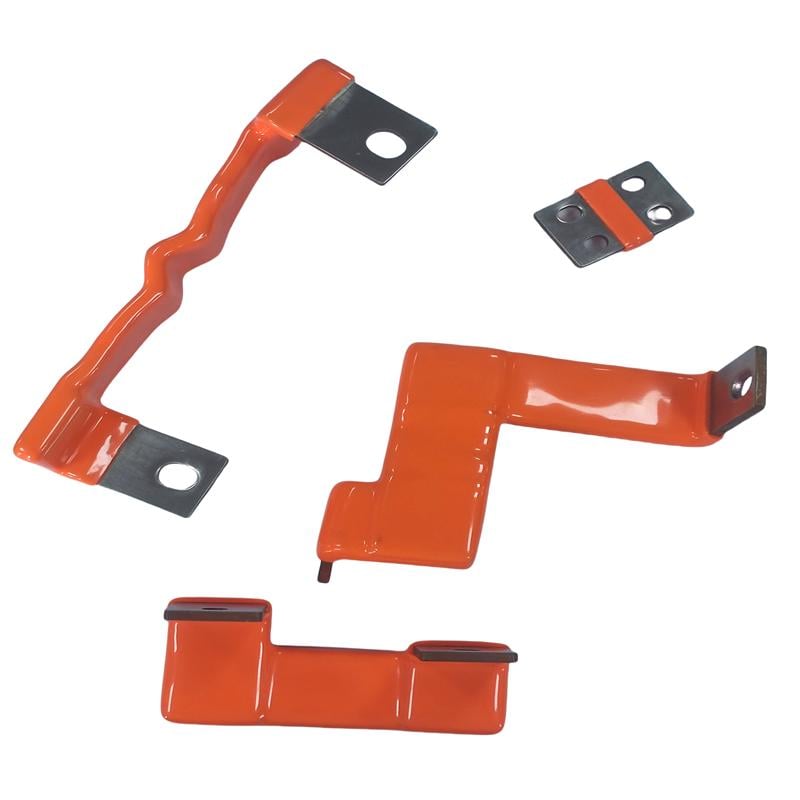
When flexible busbars become part of engineering discussions around getting a product to market, you’ll quickly hear about conductivity, insulation properties, and ampacity ratings. However, the step from a working prototype to a robust, cost-effective part made in the factory is seldom the subject of sufficiently intense scrutiny: Design for Manufacturability (DFM) reviews. The team at Kinto has completed hundreds of DFM reviews of flexible busbars in EVs, energy storage, and other industrial power electronic applications. Here, we discuss what we consider to be at the core of effective DFM.
Defining the DFM Review for Flexible Busbar Applications
A DFM review involves a structured working session with team members of diverse skillsets, product engineers, manufacturing and quality personnel, and material vendors, before any material is ordered or tooling is procured. They comb through every element of the flexible busbar design, including how laminated foil layers are arranged, the placement and quantity of holes, and how edge sealing is implemented. But rather than an itemized list of general manufacturing considerations applicable to most anything manufactured, DFM is highly application-focused. For multi-layered flexible busbars made from thin foil layers that are stacked and either welded or laminated, the review focuses on issues such as the effect of flexibility on terminal connections, layer delamination from vibration, and thermal cycling stresses on the termination system. At Kinto, the goal of any such session is straightforward: prevent cost-enhancing issues in manufacturing by uncovering potential design limitations early in the process.
How DFM Review Reduces Material Waste and Fabrication Costs
Perhaps the most tangible result of a complete DFM review is material efficiency. Flexible busbars are usually manufactured using laser-cut or precision-stamped foils, and a significant portion of the material cost is related to the thickness, temper, and material grade of each layer in the stack-up. As the design is reviewed, our specialists at Kinto examine the geometry for efficient part nesting, identifying and minimizing waste material, and looking for opportunities to achieve longer bend-fatigue life by recommending a different grain direction, up to and including an option for using a lower-conductivity alloy to reduce the number of layers where functionally acceptable. Edge preparation, ultrasonic welding, diffusion bonding, and mechanical termination methods are also reviewed. We often advise proceeding with the lowest-cost applicable option while ensuring electrical and mechanical pull-test values will be met. Frequently, tighter tolerances may be prescribed on dimensions that are unimportant, and relaxing those may enable use of a higher-speed cutting process at lower cost without any negative effect on the performance of the part. All of these measures result in a busbar with lower overall cost.
Enhancing Reliability Through Process Capability Matching
Just because a dimension looks correct on a computer display doesn‘t mean it translates to an acceptable range on the production floor, where tolerance limitations become a real quality problem. During DFM reviews, every dimension and property identified by our design engineers is evaluated and mapped to the process capability index (Cpk) of each applicable fabrication center, typically targeting Cpk ≥ 1.33 for critical dimensions. For flexible busbars, focus is placed on the required accuracy of hole-to-hole spacing, the post-stack-up stability of the overall length, and the uniformity of insulation coatings. When the tolerance value enters the “yellow” or “red” zones, we collaborate with our customers to offer revised geometries, added datum references, or changed stacking procedures that will accomplish the same functional result while significantly increasing the process window. We also review the acceptable flex range of each busbar configuration and provide the optimum stacking order in the physical layout of the stack-up to minimize stresses during forming and achieve superior anti-creep behavior. Pairing design intentions with manufacturing reality means avoiding post-production rework.
Shortening Time-to-Market with Proactive Problem-Solving
One of the least advertised benefits of the DFM review, though perhaps one of the most crucial for many development teams, is the impact it has on the development timeline. Many delays are caused by issues encountered too late to resolve quickly, tooling that will not release after the first sample, welding parameters that only fail on the second sample, or insulation material that shrinks unevenly in the curing oven. The DFM review brings those problems to light much earlier, saving weeks of iteration and frustration. Many of our DFM reviews result in an action log that details each problem identified, the proposed solution, and the necessary validation tests to be performed before project kick-off. Kinto’s review includes simulation of your manufacturing process and identification of potential production bottlenecks, such as the need for specialty tooling or careful handling of complex flexible segments. This allows clients to confidently place orders for long lead-time materials, adjust production lines to accommodate custom busbar dimensions, and significantly speed up first article inspection. A full DFM review can often reduce the number of prototypes required, shortening lead times while maintaining quality and reliability.
But at the end of the day, the DFM review isn’t a hoop to jump through, it‘s a way to engineer smarter. Your design for an ideal flexible busbar is lifted from conceptual possibility and translated into a tangible device that is a reliable component of your end product, whether that ends up in tens of thousands of cars or more. From the very first inquiry that reaches us at Kinto, we build DFM into the process, bringing decades of precision manufacturing expertise to bear. We advise on elements such as:
• Choice of base and layer materials
• Termination technique selection
• Level of insulation coverage
• Key quality control measures at each stage
Why? We’re confident the “best” busbar for the job is not simply the one that allows current to flow most effectively, but also the one that we can efficiently produce on time and on budget. That is the DFM advantage, and it forms the core of every Kinto engagement.