August 2026 | Industry News
The rapid expansion of artificial intelligence is changing not only how data centers compute, but also how they are powered.
As AI servers become increasingly power-intensive and rack-level power requirements continue to rise, traditional data center power distribution architectures are facing new challenges related to current, space, thermal management and power conversion.
In response to these challenges, NVIDIA is advancing an 800 VDC power architecture for next-generation AI factories. The company says the approach is designed to provide a more scalable power delivery path for increasingly dense AI computing infrastructure while reducing conversion stages and electrical distribution losses.
Why AI Is Changing Data Center Power Architecture
Traditional data centers were generally designed around comparatively predictable IT loads. Modern AI infrastructure is different.
Large GPU clusters can create significantly higher and more dynamic power requirements. As computing density increases, more electrical power must be delivered to each rack while available space for power conversion and distribution equipment remains limited.
NVIDIA's latest 800 VDC architecture initiative addresses this challenge by moving power distribution toward a higher-voltage DC backbone.
The basic engineering principle is straightforward: for the same power level, increasing voltage reduces the current required to transmit that power.
Lower current can help reduce resistive losses and conductor requirements, while also creating opportunities to reduce the physical size of electrical distribution components.
NVIDIA's current architecture roadmap is therefore focused not simply on supplying more power, but on developing a more efficient and scalable way to move that power through future AI facilities.
From Traditional AC Distribution Toward 800 VDC
Today's data centers commonly rely on multiple stages of electrical conversion between the utility supply and the computing equipment.
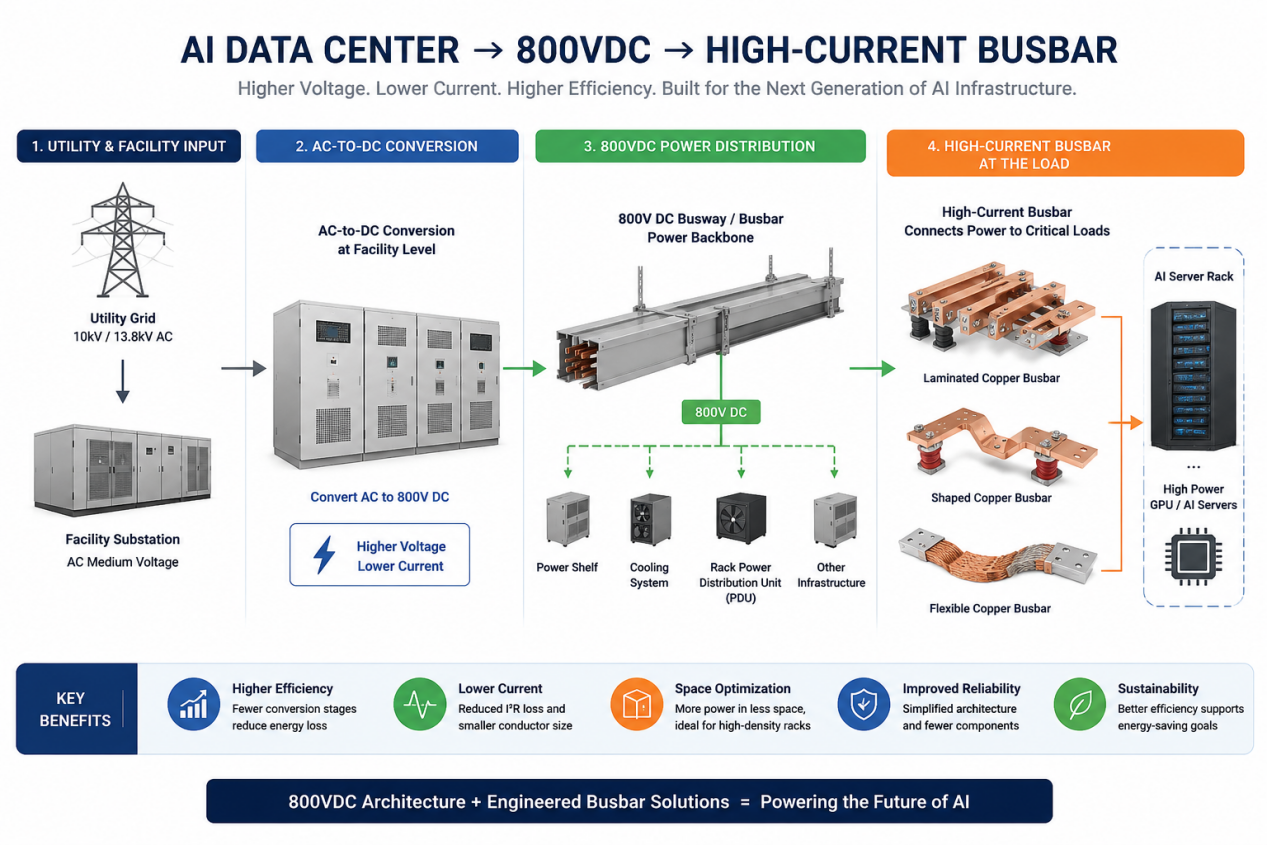
The future architecture being developed around 800 VDC aims to simplify this power path by performing AC-to-DC conversion at the facility level and distributing higher-voltage DC power closer to high-density computing equipment.
NVIDIA describes a phased transition rather than an immediate replacement of existing infrastructure. Its latest roadmap includes hybrid approaches that can work with existing AC-based facilities, as well as future architectures designed specifically around 800 VDC distribution.
This approach could allow data center operators to increase computing density without proportionally increasing the physical footprint of power distribution infrastructure.
For existing facilities, this transition path is particularly important because completely replacing electrical infrastructure can involve significant capital expenditure and operational disruption.
Copper and Busbar Design Become More Important
The move toward higher-voltage DC distribution also has implications for electrical conductors.
At a given power level, higher voltage means lower current. Lower current can reduce resistive losses and potentially allow smaller conductors to carry the same power.
NVIDIA's previous technical work on 800 VDC architecture highlighted the limitations of distributing very high power at lower DC voltages, including the substantial amount of copper required for high-current busbar systems.
However, reducing current does not eliminate the need for carefully engineered conductors.
High-power AI infrastructure still requires reliable electrical connections capable of handling substantial continuous and transient loads. Busbars, busways, connectors and other conductive components must be designed around the actual voltage, current, temperature, mechanical and installation requirements of the system.
For manufacturers, this creates opportunities for more application-specific busbar solutions rather than simply scaling conventional low-voltage designs.
An Emerging Ecosystem Around 800 VDC
The development of 800 VDC is also becoming an industry-wide effort rather than a single-company initiative.
NVIDIA reports that it has been working with Google, Microsoft and other industry participants through the Open Compute Project to develop specifications and interfaces for the emerging architecture. According to NVIDIA, more than 80 equipment manufacturers and infrastructure companies are already developing products aligned with the relevant specifications.
The development of common interfaces is important because large-scale data centers require components from multiple suppliers to operate together reliably.
Power conversion equipment, protection devices, busways, conductors, connectors and rack-level power systems must ultimately form an integrated electrical architecture.
As standards mature, the availability of compatible components could help accelerate adoption across future AI infrastructure projects.
What 800 VDC Could Mean for Busbar Manufacturing
For busbar manufacturers, the evolution toward higher-voltage DC distribution creates several areas that require careful engineering consideration.
First, conductor sizing must be evaluated according to the actual continuous and peak current requirements rather than relying on traditional low-voltage designs.
Second, insulation systems become increasingly important as operating voltage rises. Electrical clearance, creepage distance, dielectric strength and insulation materials must be evaluated according to the specific system design and applicable standards.
Thermal management also remains critical. Although higher voltage can reduce current for a given power level, high-power busbars can still experience significant heat generation at connection points and under sustained loads.
Mechanical design is another consideration. Large busbar assemblies used in data center power infrastructure may require precise bends, mounting features, insulation, plating and connection interfaces to integrate with equipment and busway systems.
These requirements make early engineering collaboration and DFM review increasingly valuable for high-power electrical projects.
Looking Ahead
The development of 800 VDC represents a broader shift in how the industry approaches power delivery for AI infrastructure.
As AI computing continues to increase rack power density, electrical architecture will become an increasingly important part of data center design.
The transition will not happen overnight. Existing facilities, safety requirements, standards, equipment availability and installation costs will all influence the speed of adoption.
However, the direction is becoming increasingly clear: future AI factories will require power distribution systems designed around substantially higher power densities than many traditional data centers were built to support.
This creates new opportunities across the electrical supply chain, from power conversion and protection equipment to busbars, connectors and high-current distribution systems.
Kinto Engineering Perspective
At Kinto, we see the development of higher-voltage DC architectures as an important trend for the future of high-power electrical distribution.
For AI data centers and other high-power applications, busbar design must consider more than current capacity alone. Conductor geometry, insulation, plating, thermal performance,
connection interfaces and manufacturability all need to be evaluated as part of the complete electrical system.
Kinto provides custom copper busbar, aluminum busbar, laminated busbar and flexible busbar solutions for applications requiring engineered electrical connections.
As AI infrastructure moves toward higher power density and new DC distribution architectures, early DFM collaboration can help OEM customers optimize busbar geometry, material utilization, insulation design and manufacturing processes before production begins.
Kinto will continue to monitor the development of 800 VDC and other emerging power architectures and support customers developing the next generation of high-power electrical systems.
Copyright © Kinto Electric Co., Ltd All Rights Reserved
 EN
EN
 AR
AR
 BG
BG
 HR
HR
 CS
CS
 DA
DA
 NL
NL
 FI
FI
 FR
FR
 DE
DE
 EL
EL
 HI
HI
 IT
IT
 JA
JA
 KO
KO
 NO
NO
 PL
PL
 PT
PT
 RO
RO
 RU
RU
 ES
ES
 SV
SV
 CA
CA
 TL
TL
 IW
IW
 ID
ID
 LV
LV
 LT
LT
 SR
SR
 SK
SK
 UK
UK
 VI
VI
 SQ
SQ
 HU
HU
 TH
TH
 TR
TR
 FA
FA
 MS
MS
 GA
GA
 LA
LA